




























7 Walling Solutions That Help Cut Construction Costs Without Cutting Corners
September 17, 2026
Construction costs are influenced by much more than the price of cement, blocks, mortar or plaster. Labour productivity, material wastage, application time, rework, surface preparation and finishing requirements can all have a significant impact on the overall project budget.
That is why choosing the right walling solutions for construction is an important part of cost-efficient project planning.
Modern walling materials and construction chemicals can help contractors and builders improve productivity while maintaining the required quality and durability. Instead of relying entirely on conventional site-mixed methods, projects can use engineered solutions that provide greater consistency and simplify application.
Ascolite offers a comprehensive range of walling solutions for residential, commercial and industrial construction, covering multiple stages of wall construction—from masonry and jointing to plastering, bonding and surface finishing.
Here are seven walling solutions that can help reduce unnecessary construction costs without compromising on performance.
1. AAC Blocks: Build More Efficiently with Lightweight Walling
The choice of masonry unit is one of the first decisions that affects wall construction efficiency.
Ascolite Fly Ash Blocks are designed as an alternative to conventional building masonry. They are lightweight precast building elements and can be used for internal walls, external walls and boundary walls across residential, commercial and industrial applications.
Because walling materials are handled repeatedly during construction, easier handling can contribute to better site productivity. A walling system that is easier to transport, position and install can help reduce the effort involved in masonry work.
Ascolite Fly Ash Blocks also offer properties such as thermal and sound insulation, mould resistance and lightweight construction characteristics.
How they can support cost efficiency
Choosing an appropriate lightweight walling material can help with:
- Easier handling and installation
- More efficient masonry work
- Reduced dependence on heavy conventional masonry methods
- Better planning of material requirements
- Potentially lower wastage through properly planned block quantities
The important point is that the most economical block is not necessarily the one with the lowest price per unit. Builders should evaluate the overall walling cost, including material handling, mortar consumption, labour and finishing requirements.
Ascolite also provides a Fly Ash Blocks Calculator, which can help estimate the quantity of blocks required for a project.
2. ASCOFIX BJM/TBM: Reduce Jointing Material and Improve Masonry Productivity
The jointing material used between blocks can have a major effect on masonry efficiency.
Traditional masonry methods can involve comparatively thick mortar joints and on-site preparation. ASCOFIX BJM/TBM is a pre-mixed, self-curing and non-shrink thin jointing mortar developed for AAC blocks and equivalent walling materials.
According to Ascolite’s product information, ASCOFIX TBM replaces conventional jointing methods requiring approximately 12–18 mm joints with a 2–3 mm thin-bed joint. The product is designed for consistent application, excellent adhesion, and higher coverage compared with conventional mortar.
Why thin-bed jointing can help control costs
Using an engineered thin-bed mortar system can help:
- Control mortar consumption
- Reduce material wastage
- Improve consistency between blocks
- Simplify mixing and application
- Improve masonry productivity
- Reduce the likelihood of uneven joints
ASCOFIX BJM/TBM is suitable for applications involving fly ash blocks, concrete blocks and hollow blocks, depending on the specific product and application requirements.
For large projects, even improvements in material control and application efficiency can make a meaningful difference when repeated across thousands of square metres of walling.
Recommended Ascolite product: ASCOFIX BJM/TBM
3. ASCOFIX GPM: Choose the Right Mortar for Medium-Bed Applications
Not every walling application should be treated in the same way. Site conditions, block type, joint requirements and surface characteristics need to be considered before selecting a masonry mortar.
ASCOFIX GPM is a premixed, self-curing medium-bed mortar designed for jointing AAC blocks. Ascolite states that it offers properties including water retention, compressive strength and self-curing performance for stable and durable joints.
How the right mortar can reduce hidden costs
Selecting a mortar appropriate to the application can help avoid problems associated with unsuitable materials or inconsistent site mixing.
Potential cost-control benefits include:
- More consistent mortar preparation
- Better workability
- Controlled material usage
- Reduced site mixing requirements
- Improved joint performance
- Lower risk of remedial work caused by poor application
For project teams, the objective should not simply be to use the cheapest mortar available. Instead, the goal is to select a masonry mortar that matches the walling material and application conditions.
That approach helps control both direct material expenditure and indirect costs associated with poor-quality workmanship.
Recommended Ascolite product: ASCOFIX GPM
4. Ready Mix Mortar: Reduce Site-Mixing Dependency
Traditional plastering can involve the procurement, measurement, sieving and mixing of individual raw materials at the construction site.
This introduces additional handling and creates opportunities for variations in mix proportions.
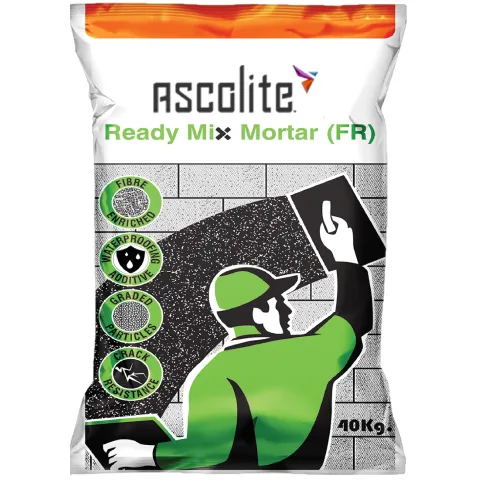
Ascolite Ready Mix Mortar is a pre-mixed cement-based wall plastering solution designed to replace the traditional site-mixed wall plaster process. It contains dry, well-graded sand mixed with cement and water-soluble polymers.
The product is designed for applications including fly ash block walls, clay brick walls, stone walls, RCC walls and conventional walls.
Where the savings can come from
A ready-mix plastering system can help improve cost control through:
Consistent mix quality: Factory-controlled formulation reduces dependence on manual batching.
Reduced preparation work: Workers do not need to separately manage and proportion multiple plastering ingredients.
Improved workability: Consistent material characteristics can make application more predictable.
Reduced rebound loss: Ascolite lists reduced rebound loss among the product’s features.
Better site organisation: Fewer loose raw materials and reduced mixing activity can make the work area easier to manage.
The financial advantage of ready mix plaster therefore extends beyond the price of the bag. It should be assessed based on material consumption + labour + wastage + productivity + finishing consistency.
Recommended Ascolite product: READY MIX MORTAR
5. READY MIX MORTAR (FR): Add Fibre Reinforcement Where the Application Demands It
Some applications require additional consideration of plaster performance, particularly where durability, shrinkage and crack control are important concerns.
Ascolite READY MIX MORTAR (FR) is a pre-mixed cement-based plastering solution incorporating 6 mm PP/glass fibre. Ascolite states that it is designed to provide improved properties relating to rebound loss, shrinkage cracks, bonding and plaster strength.
The product can be used for internal and external plastering and is specified on Ascolite’s website for applications including conventional walls, fly ash blocks, clay brick walls, stone walls and RCC walls. It is also listed as suitable for applications such as swimming pools and basement walls and for marine-atmosphere environments.
Why performance can be a cost consideration
The cheapest plastering system at the application stage may not necessarily be the most economical over the life of a project.
A more suitable plaster system can help reduce the likelihood of:
- Excessive rebound loss
- Shrinkage-related cracking
- Bonding issues
- Repeated patching
- Premature remedial work
This is particularly relevant when selecting materials for large-scale projects where even small levels of rework can multiply across thousands of square metres.
Recommended Ascolite product: READY MIX MORTAR (FR)
6. ASCOPLAST BOND & GYPBOND: Improve Adhesion and Reduce Surface-Preparation Work
Wall plastering and finishing can become expensive when poor substrate preparation leads to adhesion problems, debonding or repeated repairs.
Bonding agents can help create a better interface between the substrate and the subsequent plaster or finishing material.
ASCOPLAST BOND
ASCOPLAST BOND is a polymer-based interior/exterior bonding agent designed for application over properly prepared substrates before new plaster and Portland cement-based mixes.
It can be used over a range of structurally sound substrates, including concrete, masonry, brick, block, stone, plaster, drywall, precast concrete, wood and tile. Ascolite states that it improves adhesion and workability and can help reduce rebound loss and sagging.
GYPBOND
For gypsum plaster applications, Ascolite Gypbond is a ready-to-use, high-build bonding agent designed to help adhere gypsum plaster to different surfaces.
According to Ascolite, Gypbond creates both a mechanical key and chemical bond and can eliminate the need for hacking and cleaning in specified applications. It can be used on substrates including RCC, fly ash blocks, concrete block walls and stone walls.
The cost-saving principle
Better substrate preparation and adhesion can help reduce costs associated with:
- Labour-intensive surface preparation
- Plaster adhesion failures
- Debonding and remedial work
- Material wastage
- Reapplication of plaster
The right bonding solution should always be selected according to the substrate, plaster system and manufacturer’s technical recommendations.
Recommended Ascolite products: ASCOPLAST BOND and GYPBOND
7. ASCOPUTTY® & ASCOPUTTY®CS: Control Finishing Costs
Wall construction does not end when masonry and plastering are complete. Surface finishing is another stage where material consumption, labour and rework can influence the final project cost.
Ascolite offers two relevant wall putty solutions: ASCOPUTTY® and ASCOPUTTY®CS.
ASCOPUTTY®
ASCOPUTTY® is a highly polymer-modified, self-curing and efflorescence-resistant white cement-based wall putty. It is designed to fill fine pores in cementitious substrates and provide a smooth, white surface suitable for painting.
Ascolite states that it can be applied to fresh plaster or moist surfaces, is water-resistant and can be used on interior and exterior concrete or cement-plastered surfaces. It also lists excellent workability, adhesion, durability and no requirement for curing among its benefits.
ASCOPUTTY®CS
ASCOPUTTY®CS is a polymer-modified coarse wall putty designed to cover coarseness, undulations, imperfections and pinholes on plastered surfaces.
It is suitable for interior and exterior surfaces of AAC blocks and concrete as well as cement-plastered walls and ceilings. Ascolite also identifies it as a cost-effective solution.
How better finishing can reduce overall project costs
An efficient finishing system can help:
- Improve surface consistency
- Address imperfections efficiently
- Reduce unnecessary remedial work
- Improve workability
- Prepare surfaces effectively for painting
- Improve project finishing schedules
The goal should be to achieve the required finish with the right product and the correct application method, rather than simply applying additional material to compensate for an unsuitable base.
Recommended Ascolite products: ASCOPUTTY® and ASCOPUTTY®CS
The Real Meaning of “Cost-Effective” Construction
When builders compare walling materials, focusing only on the purchase price can lead to the wrong conclusion.
A better approach is to calculate the total installed cost.
This can include:
Material Cost + Labour Cost + Material Wastage + Handling + Application Time + Rework + Finishing Requirements = Total Walling Cost
For example, a product that has a higher purchase price but requires less labour, generates less wastage or delivers more consistent application may provide better overall value.
This is why modern construction increasingly focuses on system-level cost optimisation rather than simply selecting individual low-cost materials.
How to Choose the Right Walling Solution for Your Project
The right combination of walling products depends on several factors:
1. Type of Wall
Is the application an internal wall, external wall, boundary wall, RCC wall, AAC block wall, concrete block wall or clay brick wall?
2. Substrate Condition
The substrate condition influences the selection of plaster, bonding agents and finishing systems.
3. Desired Productivity
Large projects may benefit significantly from premixed products and systems designed to simplify on-site application.
4. Required Finish
The required surface quality should be considered before selecting the plaster and putty system.
5. Site Environment
Exposure conditions, moisture, marine environments and specific project requirements may influence product selection.
6. Total Installed Cost
Compare the complete cost of application rather than only the purchase price of one material.
7. Technical Recommendations
Product selection and application should always follow the manufacturer’s technical data sheets, approved application procedures and project specifications.
Why an Integrated Walling System Makes Sense
One of the biggest advantages of using a coordinated range of walling products is that different construction stages can be considered together.
A typical walling sequence could involve:
Fly Ash Blocks → Masonry Mortar → Plastering → Bonding Where Required → Wall Putty → Painting
When each stage is selected independently without considering the next stage, problems can arise at the interfaces between materials.
An integrated approach makes it easier to consider:
- Compatibility
- Application sequence
- Material consumption
- Labour requirements
- Surface preparation
- Final finish
- Rework risk
Ascolite’s Walling Solutions portfolio brings together products across these key stages, allowing builders and contractors to evaluate wall construction as a complete system rather than as a collection of unrelated materials.
FAQs About Cost-Effective Walling Solutions
Which walling material is most cost-effective for construction?
No single walling material is universally the most cost-effective. The right choice depends on block type, project requirements, labour availability, material consumption, finishing requirements and total installed cost.
Ascolite Fly Ash Blocks offer an option for internal, external, and boundary wall applications.
Can ready mix plaster reduce construction costs?
Ready mix plaster can improve cost control by providing consistent factory-controlled material, reducing site mixing requirements and helping manage material wastage and labour. Ascolite Ready Mix Mortar is designed as an alternative to traditional site-mixed wall plastering.
What is thin-bed mortar?
Thin-bed mortar is a specially formulated jointing material designed to create thinner joints between suitable masonry units than conventional mortar. Ascolite ASCOFIX TBM is designed for AAC blocks and specifies a 2–3 mm joint thickness.
Why are bonding agents used before plastering?
Bonding agents can improve adhesion between a prepared substrate and subsequent plaster or cement-based mixes. ASCOPLAST BOND, for example, is designed for this purpose across several structurally sound substrates.
What is the difference between ASCOPUTTY® and ASCOPUTTY®CS?
ASCOPUTTY® is a polymer-modified white cement-based wall putty designed to provide a smooth surface, while ASCOPUTTY®CS is a coarse putty intended to address coarseness, undulations, imperfections and pinholes on plastered surfaces.


